

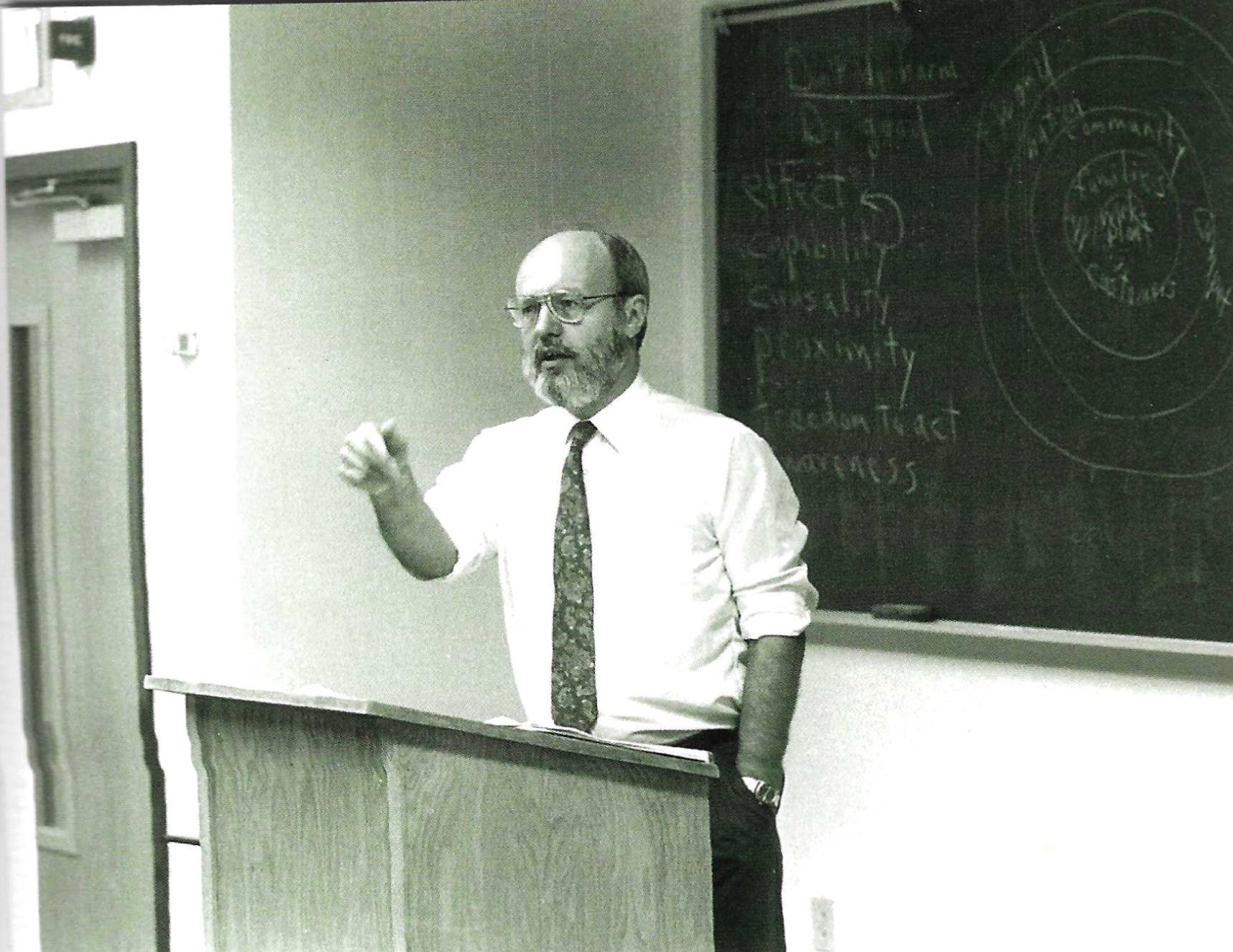
In Memoriam: John M. Kline, Professor Emeritus, International Business Ethics & Diplomacy

It is with deep respect and gratitude that we remember Dr. John M. Kline, an esteemed scholar, teacher, mentor and international advisor at the intersection of international business, ethics, and investment policy. His thought leadership pressed global business leaders, governments, and students to weigh profit against human dignity, public welfare, and environmental stewardship.
Dr. Kline earned his Ph.D. in political science from The George Washington University and held a Master’s degree from Johns Hopkins University School of Advanced International Studies. Before embarking on his distinguished academic career, he served as Director of International Economic Policy at the National Association of Manufacturers.
At Georgetown, Dr. Kline became a pillar of the School of Foreign Service, teaching for over 40 years and eventually holding the title of Professor Emeritus. During this tenure, he served as Director of the Master of Science in Foreign Service program and led the Karl F. Landegger Program in International Business Diplomacy, guiding its mission to cultivate thoughtful, ethically minded leaders in global business and diplomacy.
His academic contributions extended to visiting scholar positions, including at Fudan University’s Dr. Seaker Chan Center for Comparative Political Development Studies in Shanghai. Most recently, Dr. Kline established a professional certificate in Ethical Decision Making consisting of three open online courses that continue to influence thousands of students globally.
Professor Kline’s scholarship made him one of the field’s definitive voices. His seminal work, Ethics for International Business: Decision Making in a Global Political Economy, remains a cornerstone text in international business ethics. The book — widely adopted in universities and translated into other languages — offers a robust framework for analyzing ethical dilemmas arising when companies operate across political, cultural, and economic borders. It challenges managers and policymakers alike to consider not just profit or compliance, but human rights, environmental justice, and social responsibility.
He authored additional books including International Codes and Multinational Business, State Government Influence in U.S. International Economic Policy, and Foreign Investment Strategies in Restructuring Economies. His academic articles appeared in notable journals, including the Brown Journal of World Affairs—where his essay “MNCs and Surrogate Sovereignty” offered a prescient analysis of multinational corporations acting as quasi- governance actors—and Transnational Corporations, where his work on corporate codes of conduct and political responsibility became core reading in business and human-rights scholarship.
Dr. Kline bridged scholarship and policy practice. As a consultant to international organizations and multinational firms, he contributed to shaping policy and practice for global investment, working with entities including the United Nations, the InterAmerican Development Bank, and the Organisation for Economic Co-operation and Development (OECD), and was a member of the U.S. State Department’s Advisory Committee on International Investment. Through these engagements, he sought to embed ethical principles within the mechanisms of global capital flows and development investments.
Professor Kline’s expertise spanned global regions. He conducted significant research and consulting work in Latin America, with studies on investment reform in Chile and Mexico; across Asia, including work on Chinese FDI and emerging-market strategies; and in Africa, examining investment dilemmas in extractive industries and governance-challenged contexts.
Dr. Kline was perhaps best known for his research on and support of Alta Gracia, an apparel factory in the Dominican Republic that paid workers a “living wage” while fully respecting freedom of association and other labor rights. With co-author Sarah Adler-Milstein, Dr. Kline published Sewing Hope: How One Factory Challenges the Apparel Industry’s Sweatshops (2017). Intended for a broad audience, this book tells the full story of the Alta Gracia factory and its workers, management and community. It also explains how the factory challenges traditional assumptions that overseas “sweatshops” are economically unavoidable. As a member of Georgetown’s Licensing Oversight Committee (LOC), Dr. Kline provided guidance to the university’s leadership regarding trademark licensing policy to ensure its licensees uphold the university’s values. He advised and supported related student movements including the Georgetown Solidarity Committee.
A Life Dedicated to Global Responsibility
Through his teaching and writing, Dr. Kline was ahead of his time — long advocating that global investment ought not to be measured solely by financial returns, but by its impact on human dignity, equity, and sustainability. Many of today’s leaders in corporate social responsibility and ethical investment credit his work as foundational.
Colleagues and former students remember Dr. Kline as more than a scholar — but a mentor who cared deeply about the moral dimensions of business, growth, and globalization. His courses challenged students to think critically about real-world dilemmas: sweatshops, environmental degradation, human rights violations, corporate influence on governments, and the responsibility of multinational enterprises in shaping global justice.
Dr Kline’s legacy is defined by integrity, clarity of thought, and a commitment to ensuring that global business serves the public good. His life’s work continues to guide conversations about corporate accountability, sustainable investment, and the ethical obligations of firms in a global political economy. Known for his kind and giving nature, Dr. Kline was a beloved teacher who influenced generations and will be missed by friends, colleagues, and former students around the world.
Dr. Kline died at the age of 78, surrounded by his family on Sunday, November 23, 2025. He is survived by his wife, Rosita A. Kline, two daughters Christina (COL ’97) and Cecilia (COL ’02), and two grandsons, Forte and Sebastian, his brother Carl Kline, and sister Mercia Kline.
Condolences and memories may be shared on the family’s memorial page