

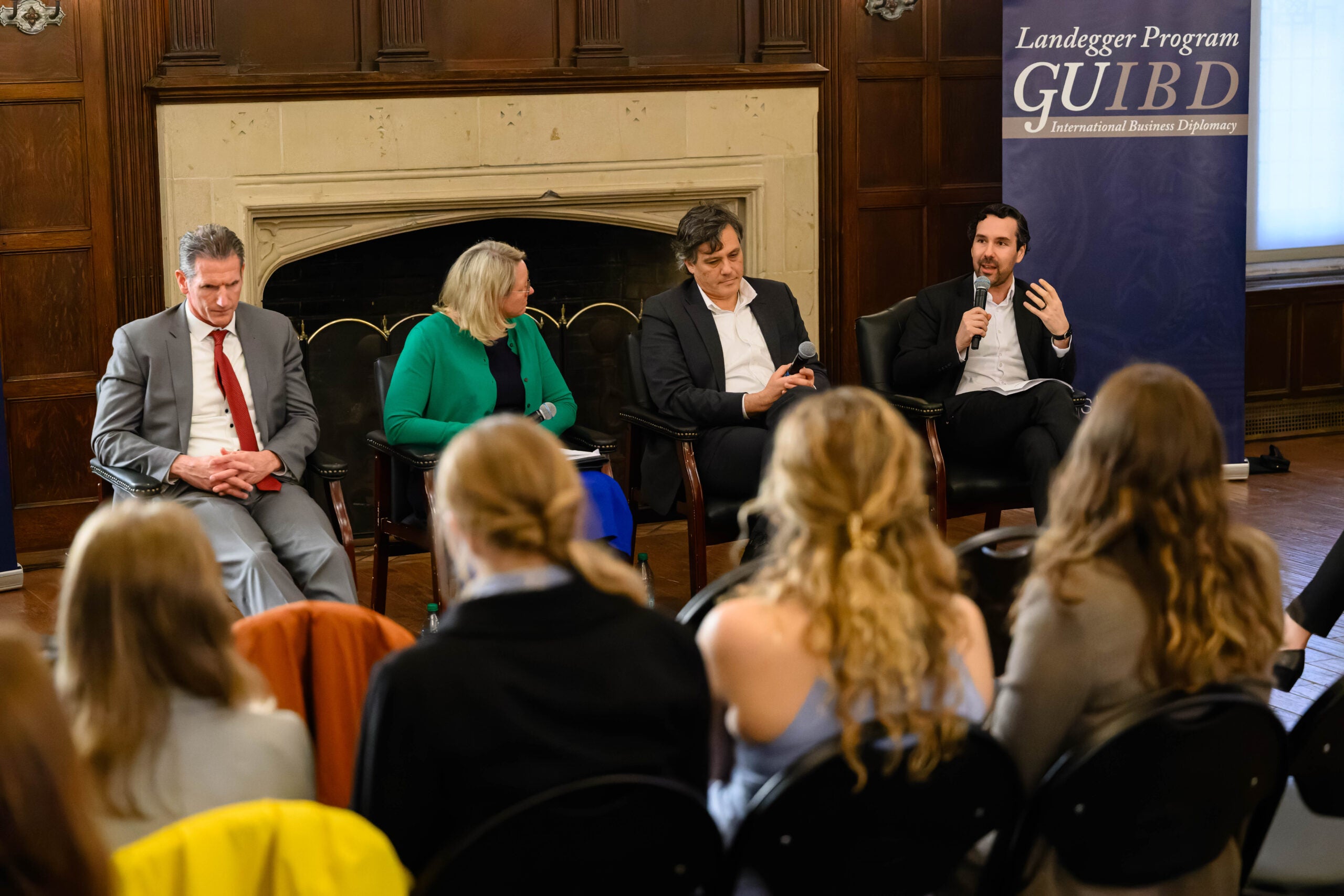
IBD Hosts 3rd Annual Mody Colloquium on Illicit Finance and Corruption
On March 12th, 2026, the Landegger Program in International Business Diplomacy hosted the 3rd annual Mody Colloquium on Illicit Finance and Corruption, made possible with funding from Dr. Sanjay Mody (SFS ‘95). This year’s event focused on “Economic National Security and Anti-Corruption in the Trump Administration.”
Professor Alex Zerden moderated a conversation with a distinguished expert panel in the field of illicit finance, including: Peter Harrell, visiting Scholar at Georgetown’s Institute of International Economic Law; Jodi Vittori, Professor of Practice and Concentration Co-Chair for Global Politics and Security at Georgetown’s School of Foreign Service; and, Chip Poncy, Global Head of Financial Security at K2 and GU Law Center Alum.
The panel kicked off by providing a historic framing of the US government’s actions in regulating money laundering and other forms of illegal economic activity. Poncy discussed how the DHS had originally been a shake up in the institutional strategy of the US to tackle terrorism and its financing. Originally, many countries failed to provide support to the US in these efforts as they did not know about anti-money laundering (AML). The US government had come to notice that the system was being taken advantage of, mentioning that the rules don’t matter if you don’t have the political will to take action. Poncy shared that it wasn’t until after 9/11 that the US noticed that financial information could be a real asset in economic national security.
The conversation continued with Peter Harrell focusing on the Trump administration’s use of tariffs and investments as international strategy. Harrell pointed out how, in comparison to the last Trump Administration, this current administration uses sanctions much less. Rather, Trump is blending economic tools with military tools to put pressure on adversaries. Further, Harell explained, Trump has started using a trade agenda to bolster support from trade partners. For example, using trade deals to create new mandates on trade partners regarding economic security, like due diligence strategies.
The panel continued with Dr. Vittori providing a background on kleptocracies and whether the US fits those characteristics. Vittori emphasized that the creation of a kleptocracy is never accidental, it occurs when a purposeful effort by those in power is made to take the money they receive from corruption to stay in power. The main priority of a kleptocracy is not national security, but rather staying in power. Vittori highlighted that a kleptocracy cannot maintain a liberal democracy for long, it will begin to shift toward an authoritarian regime.
All three panelists provided further discussion on the role of crypto in financial markets.The panel provided valuable insights covering arguments from both sides of the modern political spectrum in the US, and provided insight into the dangerous role crypto plays as a new avenue in aiding money laundering.
The event concluded with a great Q&A and reception where the audience got to engage with panelists directly about the colloquium’s central theme.